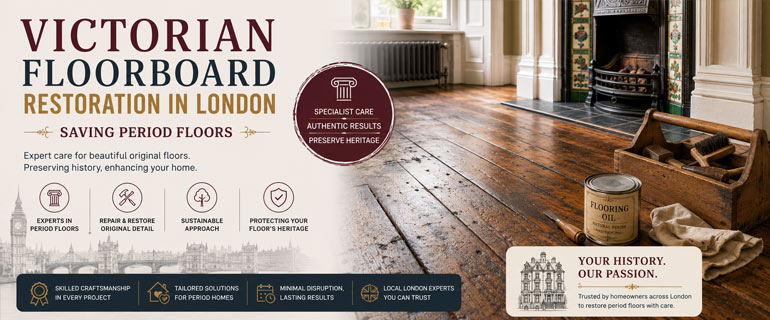
A significant share of London homes were built during the Victorian era, roughly 1837 to 1901, and many still have their original softwood floorboards, often hidden under carpet or lino for decades. Once uncovered, these boards usually need genuine work, but they also carry a character and material quality that modern flooring simply can't replicate.
Original boards are typically pine or deal, cut wide from old-growth timber that grew slowly and developed a density and tightness of grain that modern, faster-grown timber doesn't match. Properly restored, these floors last many more decades and contribute genuinely to how a period property feels.
Common Problems In London Victorian Floors
A thorough assessment comes before any sanding begins. The most common issues:
- Gaps between boards, from shrinkage over a century or more of repeated heating cycles.
- Raised or protruding nails, from the original Victorian fixing method.
- Boards at different heights, from uneven settling or previous repairs.
- Water damage or staining, often concentrated near window bays or external walls.
- Mismatched replacement sections, from repairs carried out at some point across the property's history.
- Old paint, occasionally lead-based, particularly in rooms once used as kitchens or bathrooms.
Raised nails need punching well below the surface, and uneven boards may need levelling before sanding. Where lead paint is present, that's genuinely significant: lead-based paint remained legal for sale and use in the UK until 1992, so any paintwork predating that could contain it, and specialist disposal procedures apply if it's confirmed.
Should You Fill The Gaps?
This is one of the more genuinely contested decisions in period floor restoration. Many homeowners want gaps filled for warmth, draught exclusion, and a smoother feel underfoot. Others prefer leaving some gaps as part of the floor's authentic character.
A few approaches contractors actually use:
- Flexible wood filler or caulk: effective for small gaps, though it can shrink and pull away over time as boards continue moving with the seasons.
- Slivers of matching timber: a more permanent, visually consistent solution, though genuinely time-consuming to fit properly.
- Tinted resin fills: suited to larger voids, colour-matched to the surrounding timber.
For wider boards with more substantial gaps, timber sliver gap filling tends to give the best long-term result. For narrow gaps under roughly 5mm, a good quality flexible filler is usually sufficient on its own.
Sanding Victorian Boards Carefully
Victorian pine is typically softer than hardwood and wears away faster under a sanding drum, which matters particularly on boards that have already been sanded once or twice across the property's lifetime. A good contractor uses the coarsest grit genuinely necessary rather than defaulting to the most aggressive option, to avoid removing more material than the floor can afford to lose.
Boards are sanded along the grain, and since Victorian floors are usually laid in straight runs parallel to the longest wall, the main direction is generally straightforward. The real challenge tends to be hallways and staircases, where access is awkward and the boards run narrower.
Finishing Original Victorian Floors
A few finish considerations specific to period boards:
- Hard-wax oil (Osmo is a well-known option) enhances the grain and colour of pine without the plastic-looking sheen of high-gloss lacquer, and it's repairable in sections, well suited to the wear patterns of a busy hallway or kitchen.
- Water-based lacquer in a satin or matt sheen offers a tough, low-odour, quick-drying alternative that keeps the pine's natural colour rather than adding the amber tone oil-based products introduce.
- Traditional wax still has genuine supporters in period property circles, though it needs more regular upkeep and isn't suited to areas that get wet, like kitchens.
If you're weighing up a colour change alongside restoration, wood floor staining applied after sanding lets you shift the tone while keeping the original boards, and periodic re-oiling keeps a hard-wax finish looking its best between full restorations.
What To Expect In Terms Of Cost
Victorian floorboard restoration typically costs £25 to £45 per square metre for sanding and finishing, broadly similar to standard hardwood sanding. Significant gap filling, nail punching, or board repairs add to preparation time and therefore the total. A full Victorian terrace with four or five rooms of original boards might run somewhere between roughly £2,000 and £4,500 to restore fully, depending on condition.
That investment generally compares favourably against replacement. New engineered oak or comparable solid timber typically costs considerably more, and the character of genuinely original boards can't be matched by anything new.
Preserving The Character Of A Period Home
Restoring rather than replacing original Victorian floors fits the wider principle of preserving what makes a period property distinctive. Natural colour variation, slight unevenness, and the visible marks of a century or more of use give a home something new materials simply can't replicate. Where damage genuinely goes beyond repair, floorboard replacement matched as closely as possible to the surrounding boards is the right call rather than forcing a full restoration on unsalvageable sections.
Victorian Floorboard Restoration: Common Questions
Should I fill the gaps in my Victorian floorboards, or leave them as character?
It's genuinely a personal choice. Filling improves warmth and draught exclusion, while leaving them preserves some of the floor's authentic character, timber slivers tend to give the best long-term result if you do choose to fill wider gaps.
How do I know if my Victorian floor's paint contains lead?
If any of the paintwork predates 1992, when lead-based paint was still legal for sale and use in the UK, it's worth professional testing before sanding, particularly in rooms once used as kitchens or bathrooms.
Is Victorian pine harder or softer to sand than hardwood?
Softer, and it wears away faster under a sanding drum, which is exactly why a good contractor uses the least aggressive grit that still achieves the result, particularly on boards already sanded once or twice before.
Is it worth restoring original Victorian boards rather than replacing them?
In most cases, yes. Restoration typically costs considerably less than replacement with comparable new timber, and the character of genuinely original boards can't be matched by anything new.
Call us on 020 7036 0625 or request a free site visit — we work regularly with period properties and can advise on the right approach for your specific floor.