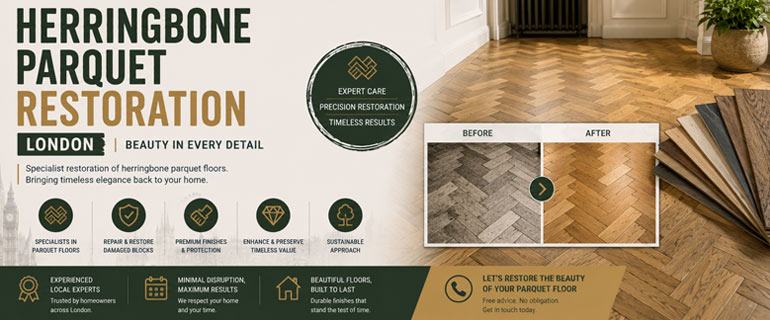
London has some of the finest examples of herringbone parquet flooring in the country, found in period homes from Edwardian mansion flats in South Kensington to interwar houses in Hampstead and Dulwich. When properly restored, these floors are genuinely spectacular. But the restoration process is more complex than standard floor sanding and requires a contractor with specific experience.
What Is Herringbone Parquet?
Herringbone parquet consists of rectangular wooden blocks arranged in a V-shaped zigzag pattern, each block laid perpendicular to the adjoining row to create the characteristic interlocking design. Traditional London herringbone floors are typically made from oak, though beech, teak, and pine examples exist. The blocks are usually 230mm to 300mm long, 70mm to 90mm wide, and 20mm to 22mm thick.
The floor system was popular in London from the 1890s through to the 1950s. Many examples were installed in high-end residential buildings, hotels, and institutional buildings. Surviving domestic herringbone floors are increasingly prized.
Assessing the Condition of Your Floor
Before any restoration work can begin, a thorough assessment is needed. The key things to evaluate are:
- How many blocks are loose, raised, or missing
- Whether any blocks show signs of beetle damage or rot
- The thickness of remaining wood above the tongue (determines how much material remains for sanding)
- Whether the bitumen adhesive is still bonding effectively or has failed across significant areas
- The extent of any staining, particularly near windows or doorways
A specialist contractor should spend 20 to 30 minutes on this assessment before providing a quote. Be cautious of anyone who quotes without inspecting the floor in person.
The Restoration Process
Herringbone parquet restoration is a multi-stage process that typically takes two to four days for a medium-sized room.
Stage One: Block Repair and Rebonding
Loose blocks must be removed, the old adhesive cleaned away, and the blocks re-laid using a modern adhesive suitable for wooden block floors. Mapei Ultrabond P990 and Sika T-54 are commonly used in London. Missing blocks need to be sourced and matched. For older London floors, salvage yards such as Lassco in Borough can be a good source of matching period oak blocks.
Stage Two: Sanding
Sanding herringbone requires a different approach from strip floor sanding. The initial passes must be made diagonally to the pattern to level the blocks without catching the edges. An experienced operator will adjust machine pressure and angle throughout. The edge work requires particular care -- rotary edge sanders can damage the corner blocks if not handled properly.
Stage Three: Finishing
The finish choice for herringbone parquet is important. Oil finishes enhance the natural character of the wood and allow for easier local repairs. Hardwax oils from Osmo or Rubio Monocoat are popular choices in London, giving good protection while maintaining an authentic period appearance. For properties with heavy use or where water resistance is a priority, a hard-wearing lacquer from Bona provides excellent durability.
How Much Does Herringbone Parquet Restoration Cost in London?
Herringbone restoration is among the most expensive floor work you can commission in London. Realistic costs for 2026:
- Good condition floor, oil finish, medium room (20 to 25m2): £1,200 to £1,800
- Floor requiring significant block replacement and re-adhesion: £1,800 to £3,500
- Large reception room (40m2+) with full restoration: £3,000 to £6,000+
These prices reflect both the skill premium for specialist herringbone work and London's higher baseline labour costs. The investment is generally justified given the quality and heritage value of original London parquet floors.
Finding a London Parquet Specialist
Not every floor sanding company in London has genuine herringbone expertise. Ask directly about the number of herringbone restoration projects the contractor has completed, and ask to see photographs of completed work. Bona's certified craftsman directory and the Contract Flooring Association are both good places to start. Word of mouth from architectural salvage dealers and period property specialists in London can also be valuable -- these professionals often know which contractors do the best restoration work in the city.